Safety in Healthcare, Assistive, and Surgical Robotics
Close interaction with people and vulnerable users, where physical safety, human factors and reliable assistance must be considered together.

Beyond the Lab: From Robotics and Embodied AI Researchto Deployable Systems
Full-day workshop
Seoul, Republic of Korea
Proposed workshop · acceptance pending.
Robots are becoming more capable. Demonstrating that a complete system can operate safely in the real world remains a different challenge. How do research advances in perception, learning, planning and control translate into systems that people can trust in daily use?
Making that transition requires safety to hold across robot design, autonomy, human interaction, validation and certification. For learning-based systems and foundation models, this also means understanding how changes in data, context and behaviour after deployment affect the assumptions and evidence on which safety claims rely.
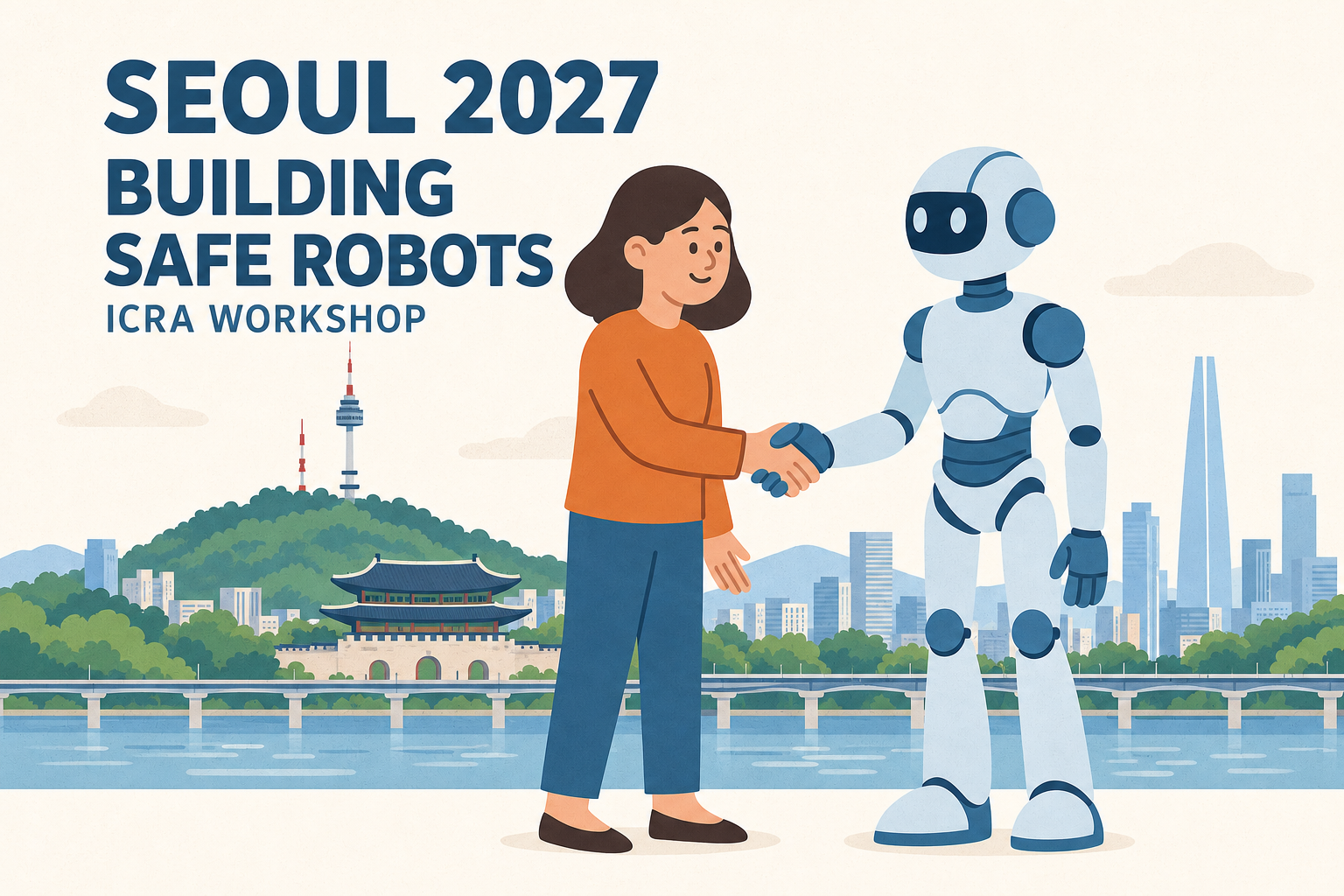
To address these challenges, the 2nd Workshop on Building Safe Robots brings researchers, practitioners, and certification and regulation experts into the same conversation. Together, we will examine the assumptions behind research claims, the constraints encountered in deployment, and the evidence needed to connect the two.
Building on the 1st Workshop on Building Safe Robots (2025), we focus on three application domains:
Close interaction with people and vulnerable users, where physical safety, human factors and reliable assistance must be considered together.
Deployment under productivity, human interaction and operational constraints, connecting safe robot behaviour with practical industrial use.
Changing environments and demanding operating conditions, including nuclear and construction robotics.
Each domain combines an academic perspective, a practitioner perspective, and a moderated Safety Translation Debate with a certification or regulation expert. Speakers will examine what is ready for use, what still fails in practice, and what validation is needed.
Contributed presentations and interactive clinics will bring participants’ own deployment questions into these discussions. A closing synthesis will build a Lab-to-Real Safety Gap Map: shared barriers, domain-specific challenges, and priorities for research, validation and assurance.
For questions about the workshop or contributions, please contact: